
Read the signal before acting
Check the token contract, pool, observation period and timestamp. Match the reported value to the rule below. Source coverage and freshness determine whether the required inputs can be evaluated in the selected view.
A signal records a market condition. It does not identify the traders, predict a profitable entry or submit an order. Confirm an executed trade through its transaction status.
The basic conditions
| Condition | Required observation | What it does not prove |
|---|---|---|
| New launch | A recorded launch within the last ten minutes | That it is the first row you have seen or that every launch was indexed |
| Migration | Provider-confirmed graduation | A transition inferred from a price increase |
| Price momentum | At least +30% over five minutes | Continued upward price movement |
| Price decline | −20% or lower over five minutes | The identity or intention of the sellers |
| Buying activity | At least 50 trades, with buys at least 70% of five-minute trade count | Positive net dollar flow or 50 unique traders |
| High volume | At least $10,000 over five minutes | Organic activity or a profitable trade |
Activity conditions require inputs received within 90 seconds in the documented rule set. That measures receipt freshness; an upstream source may have its own indexing or caching delay.
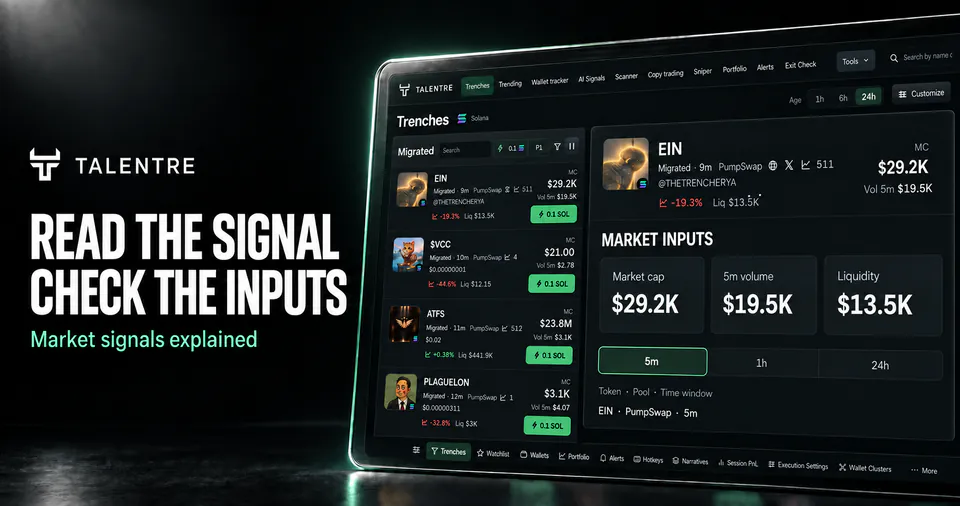
Evaluate a signal step by step
Illustrative example: An invented five-minute snapshot contains 80 buys, 20 sells, +12% price change and $9,500 volume, with data received 30 seconds ago.
- The trade count is 100, above the required 50.
- The buy share is 80%, above the required 70%. The buying-activity condition is met.
- A +12% move does not meet the +30% momentum condition.
- $9,500 does not meet the $10,000 high-volume condition.
The correct result is one matching count-based condition, not three broadly positive labels. Nothing in these inputs identifies the traders or proves that total buy value exceeded total sell value.
Check the required history
These conditions compare several observations within a defined window. A single snapshot is insufficient:
- Volume acceleration
- For a pool at least one hour old, five-minute volume is at least $5,000 and at least three times the preceding 55-minute average pace.
- Buy pressure fading
- Three observations at least five minutes apart each have at least 30 trades. Buy share falls at each step and by at least 15 percentage points overall while price rises.
- Activity drying up
- Two observations at least five minutes apart show volume and trade count falling by at least 60%, from an earlier window with at least $5,000 volume and 30 trades.
- Failed breakout
- After sufficient observations and warm-up, a break above a locally observed level is followed by two observations below it within the specified confirmation window. The level is not an all-time high.
Without the required history, the condition cannot be evaluated. Missing observations are not evidence that the condition is false.
Review a signal against its original data
Compare the same pool and period on the chart. A later price does not reproduce the snapshot behind the label. When reporting a discrepancy, include the trigger value, source, timestamp and contract.
Use the signal reference for the full thresholds and history rules, and check the market-data definitions when comparing fields.
Find your next research target